

Stop "Trying" to Exercise: 5 Science-Backed Mindset Shifts for Real Adherence
TL;DR
Ever wonder why the drive to hit the studio can feel so elusive at times? It’s not a lack of willpower—it’s actually a psychological "gap" between our conscious intentions and the automatic impulses our brains use to save energy. I was recently asked this question by a member: “how are some of your students so motivated to be at the studio so often?” That got me thinking about motivation and when we feel we are lacking it, why? And, how can we self-motivate without using guilt as a driver and feeling worse about ourselves when we don’t make it happen?
In this post, we’re breaking down why the "couch" often wins and how you can flip the script by mastering process goals—the "secret weapon" for building long-term consistency over high-pressure outcomes. Whether you’re a Well Studio regular or just starting your journey here in Dublin, the ultimate key is shifting from "trying" to exercise to building a permanent identity as someone who values movement. Read on for the science-backed roadmap to making fitness an automatic part of your life.
You’re not the only one who struggles to get up, get moving and get your workout in! As the saying goes, the first steps is usually the hardest!
1. The Intention-Behavior Gap: Diagnosing the Architecture of Failure
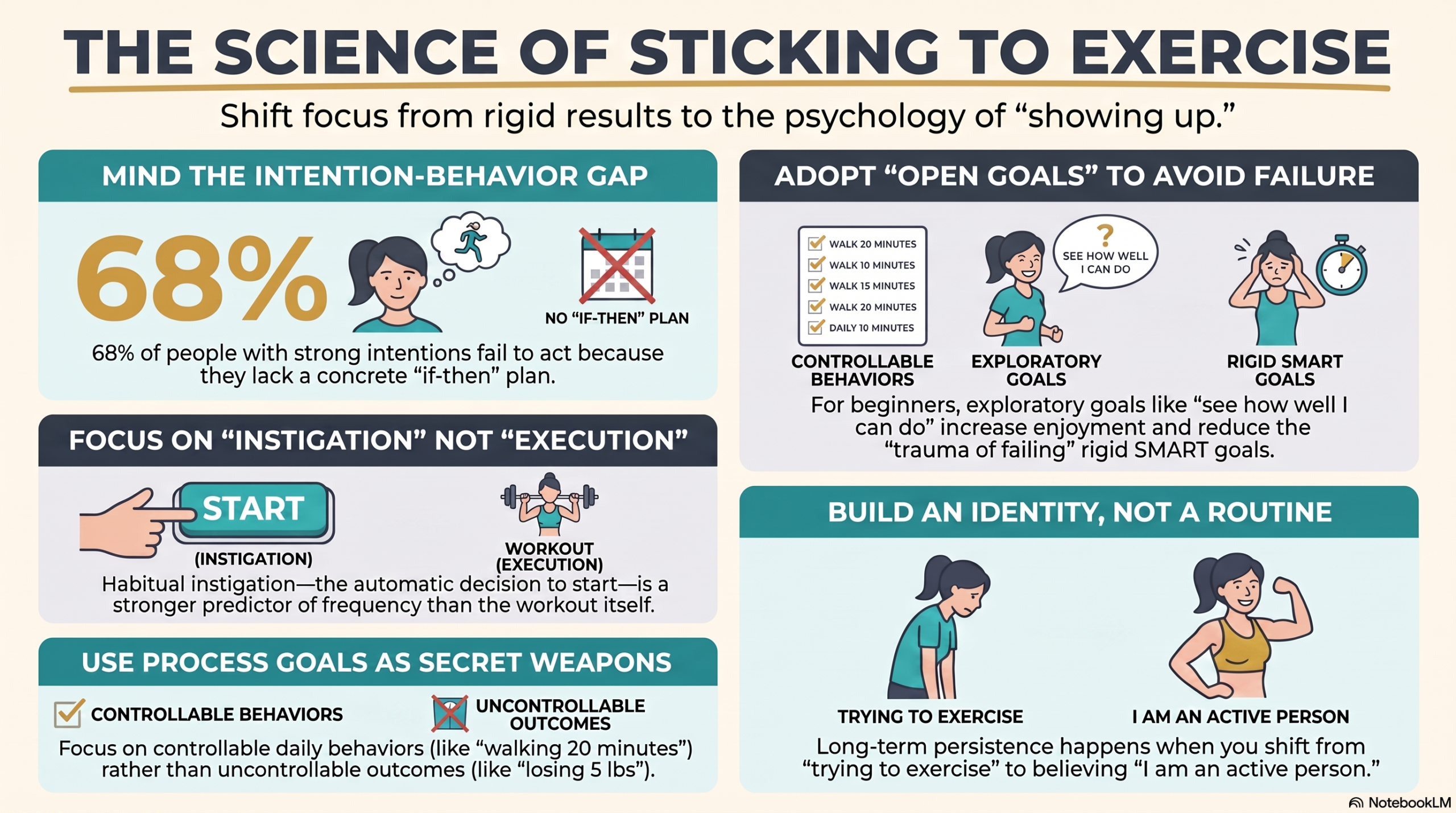
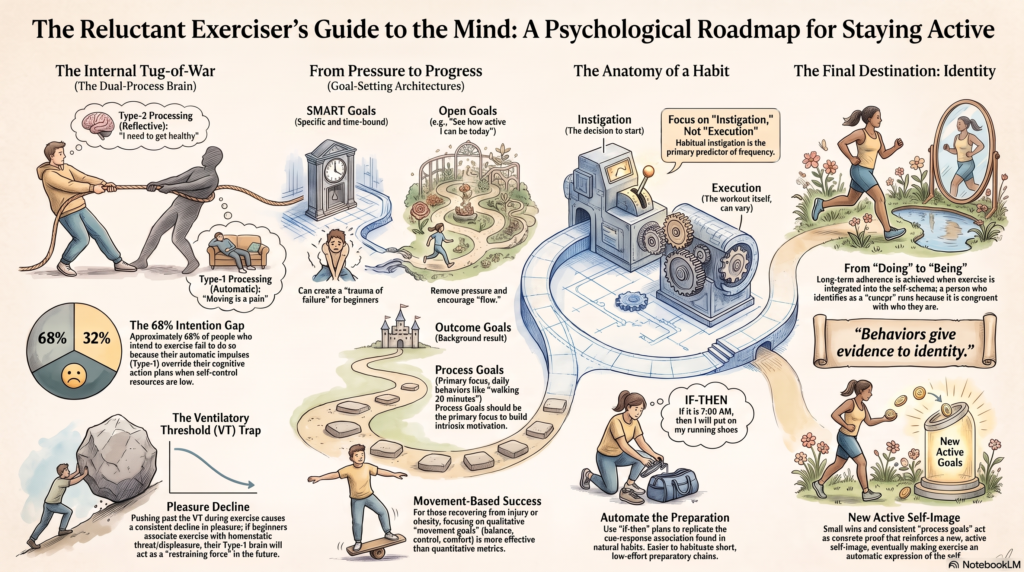
We are currently facing a systemic crisis of movement. Research confirms a staggering Intention-Behavior Gap: roughly 68% of individuals who possess a genuine intention to exercise fail to act on it. Even more telling is that nearly 29% of “active maintainers”—those who have already established a routine—eventually relapse into inactivity.
If you find yourself stuck on the couch despite “knowing” you should move, we must diagnose the failures in your behavioral architecture. The problem is rarely a lack of discipline; rather, it is often the direct result of common advice—like rigid goal setting or “pushing through the pain”—that actively sabotages the brain’s motivation centers. By shifting from a reliance on raw willpower to evidence-based strategies, you can finally bridge the gap between intention and action.
2. Ditch the SMART Goal for the "Open" Goal
Traditional SMART goals (Specific, Measurable, Achievable, Relevant, and Time-bound) often create a binary, high-pressure environment of success or failure. For many, especially beginners, failing to hit a precise target leads to performance anxiety and guilt. To remove this “trauma of failing,” behavioral science suggests adopting Open Goals.
Open Goals are phrased as exploratory questions rather than rigid demands. Instead of “I will run 5 miles in 45 minutes,” an open goal asks, “See how well you can do today,” or “See how active you can be.” This shift allows for higher levels of enjoyment and “flow,” as it removes the cognitive burden of constant self-judgment. By focusing on progress rather than perfection, you build the confidence necessary for long-term adherence.
“It took away the trauma of failing.”
3. Master the "Instigation Habit," Not the Workout
Behavioral psychology distinguishes between Habitual Instigation (the automatic decision to go) and Habitual Execution (the procedural steps of the workout).
A counter-intuitive but vital finding is that instigation habit strength is the primary predictor of exercise frequency. In fact, Habitual Execution has no significant effect on how often you exercise once the instigation habit is controlled for. This means it doesn’t matter if your workout varies every day—what matters is the automated trigger that gets you moving.
To capitalize on this, focus on “low-friction anchors”—simple preparatory actions that act as the automated start for a higher-order sequence:
- Packing your gym bag the night before.
- Putting on your running shoes immediately after work.
- Keeping your yoga mat unrolled in a visible common area.
“It’s Not What You Do, but How You Get Yourself to Exercise That Matters.”
4. Listen to Your "Type-1" Brain (The ART of Moving)
The Affective-Reflective Theory (ART) posits that exercise behavior is a result of a dual-process model. Your brain is constantly balancing Type-1 processes (automatic affective valuations or feelings) and Type-2 processes (reflective cognitive evaluations or intentions).
When you are stressed or tired at the end of the day, your self-control resources deplete, and you default to Type-1 automatic impulses. If your past experiences have encoded a negative feeling, your brain acts as a restraining force.
The Power of Type-1 Associative Tags
Your brain utilizes what is called summative affective valence—a cumulative memory of past emotional experiences with exercise. If your memories are “tagged” with feelings of embarrassment or exhaustion, your Type-1 brain will trigger an impulse for inactivity. To succeed, you must focus on building positive associative tags by prioritizing energy, calmness, and pleasure during your movement sessions.

5. Stop Fighting Your Ventilatory Threshold
The “no pain, no gain” mantra is a dangerous prescription because it ignores the Dual-Mode Model of affective response. This model identifies the Ventilatory Threshold (VT) as the point where exercise intensity shifts from pleasant to unpleasant.
- Below the VT: Physiological homeostasis is maintained, and exercise feels consistently pleasant.
- Above the VT: The brain receives interoceptive signals of homeostatic threat. At this point, pleasure declines sharply into displeasure for almost everyone.
Consistently pushing into a state of perceived physical “threat” encodes a negative Type-1 tag, making the automatic impulse to avoid exercise stronger. To build positive automatic valuations, prioritize self-paced exercise. By keeping your intensity below the VT, you protect your psychological resources and make it easier for your brain to “vote yes” for the next session.
6. Shift Your Identity from "Doing" to "Being"
Identity change is the only surefire way to persist. When exercise moves from an external chore to a part of your self-schema, it no longer requires constant negotiation. This creates a powerful feedback loop: identity drives behaviors, and concrete behaviors (small wins) provide the evidence that strengthens the identity.
Consider the example of an 80-year-old runner who continues to tackle uphill 15K races; she doesn’t do it because of a rigid goal, but because she is a runner, and runners run. Similarly, Arnold Schwarzenegger at age 72 still works out at 7 a.m. every single day. For these individuals, exercise is integrated into who they are.
Stop viewing exercise as a task to “check off” and start seeing every small movement as a vote for the person you are becoming. If you see yourself as a physically active person, you will naturally seek behaviors congruent with that identity.
The Takeaway: The Path to Mastery
Sustainable adherence is not about increasing your willpower; it is about improving your behavioral architecture. By utilizing Open Goals, mastering the Habitual Instigation of "low-friction anchors," and respecting your physiological Ventilatory Threshold, you transform exercise from a battle into an automated expression of your identity. In the end, keep it simple and just choose the start!
If you imagined yourself as a consistent exerciser a year from now, what is that person like—and what small win will you use today to prove that person exists?
Sources
Here are the URLs and persistent identifiers for the research papers, clinical reports, and professional articles I used to draft this blog post:
- Setting S.M.A.R.T. Fitness Goals to Overcome Mental Hurdles (NASM Blog): Explains the differences between Outcome, Process, and Performance goals and how to use the SMART acronym to build structure and adherence.
- The Outcome and The Process: How to Set Effective Goals (Dr. Sharon Gam): Highlights the “secret weapon” of focusing on process goals (daily habits) over outcome goals to build long-term intrinsic motivation.
- Comparing the effects of goal types in a walking session (ResearchGate): Provides preliminary evidence that “open goals” (e.g., “see how well you can do”) can be more effective and enjoyable for beginners than rigid SMART goals.
- Link: ResearchGate Article
- Affective-Reflective theory in exercise and physical inactivity (Yongjin Lee): Explores why we often choose the couch over the gym due to automatic “affective valuations” and how past negative experiences can act as a restraining force.
- The Key to Exercise Behavior Change Is Identity Change (Psychology Today): Argues that the most sustainable way to maintain fitness is to integrate it into your identity—becoming “the kind of person who exercises”.
- Link: Psychology Today Article
- Exercise, Affect, and Adherence: An Integrated Model (PMC): Discusses the importance of self-paced exercise to maintain a positive “core affect,” ensuring workouts are pleasant rather than exhausting.
- A Systematic Review of Habit and Physical Activity (PMC): Deconstructs the habit loop into “instigation” (deciding to go) and “execution” (the workout itself), noting that habitizing the decision to start is the most important factor for frequency.
- Self-Determination and Adherence in Personal Training (PMC): Examines how professional coaching and fitness academies support the three basic psychological needs—autonomy, competence, and relatedness—to boost adherence.
- A Behavioral Perspective for Improving Exercise Adherence (PMC): Reviews psychological mechanisms like “Effort Justification,” where working hard for a goal actually makes us value it more.
- Barriers to home-based physical activity among women (PMC): Identifies how time constraints and domestic roles impact motivation and provides data on regional inactivity rates.
- Barriers to physical activity among community-dwelling older adults (PMC): A systematic review of what stops seniors from exercising, such as fear of falling or lack of social accompaniment.