
Summary
About ten years ago, my family began a deep health journey after our children were diagnosed with PANDAS, an autoimmune condition triggered by infection and immune dysregulation. Our approach to healing centered on the “three I’s”: eliminating infection, reducing inflammation, and rebuilding immune regulation—mainly through identifying and minimizing toxins, improving diet, and supporting the body naturally. Over time, we adopted testing-based wellness practices (blood, stool, and urine tests) to track progress and adjust protocols, supported by holistic professionals. In doing so, we've learned what diagnostic test numbers to pay attention to and how to act on them.
Recently, I explored Superpower, a personalized health tech company that combines biomarker, genetic, and fitness data with AI-backed physician guidance to create custom wellness plans. I appreciated its simplicity, actionable insights, and personalized checklists focused on hydration, sunlight, nutrition, exercise, and sleep. The post concludes by encouraging readers new to diagnostic testing to start small, seek expert support, and use testing as a tool for preventative, informed health optimization.
Back Story
About a decade ago, our son had a sudden change in behavior, which led us, as a family, down a new path in terms of how we approach health and wellness. Both of our children were soon diagnosed with an autoimmune condition called PANDAS. At a super high-level, this condition starts with an infection, which then leads to inflammation and immune system dysregulation. There’s no easy fix; no one medication or treatment option. At the time, most of the medical world didn’t even recognize PANDAS/PANS as a diagnosis. We were lucky enough to find a pediatrician who understood this condition and set us on a path to healing.
That path centered on the three “I’s”: (eliminate) infection, (reduce) inflammation and (rebuild) immune regulation. The body is an amazing system that can heal itself when properly nourished and the right surrounding environment. We looked at many forms of toxicity that we are exposed to in our daily lives which gnaw at our immune systems and wear it down and “confuse” it; everything from dirty electricity, 4/5G interference, water, mold exposure, ultra-processed foods (UPFs), chemicals in household items such as carpets, furniture, mattresses and bedding along with foods and personal that our bodies may be sensitive to. Everything we put into and on our bodies along with what surrounds those bodies on a regular, day-to-day basis. There are some things you want to know and other things you’d prefer to not have uncovered! The rabbit holes of research seemed endless and the out-of-pocket costs associated with treatment and lifestyle changes can be overwhelming. To identify the sources of toxicity and to monitor immune responses, we did loads and loads of testing. Testing for:
- Water quality
- Air quality
- Mold Exposure
- Wifi-4/5G exposure
- Allergies & Food Sensitivities
- Titers and nutrient imbalances (bloodwork)
- Gut microbiome imbalances (stool testing)
- Kidney & Liver function (urine testing)
In future posts, I intend to dig into each of these a bit deeper to share my learnings and some of the tactics we’ve implemented. Some have been life changing, others…well, not so much. There are a TON of tools out there to diagnose and others for implementation. For now, I’m going to hone in on the human testing (e.g. blood/stool/urine) diagnostic tools and what knowing your “numbers” can offer. As a practice, we have implemented annual testing to see where our numbers are at and change our protocols appropriately. What does this mean specifically? We do bloodwork, stool tests and/or urine tests to understand what’s truly going on inside of our bodies and how they work for, or against, us. The testing (diagnostic) part is the easier part! Sifting through and interpreting the results to then come up with a plan…that’s where the real work lies.
For many years, and still to this day, we heavily rely on our pediatrician, a holistic nutritionist and our favorite acupuncturist to help us with ordering the most applicable tests, then going through the data to come up with a plan. Each plan is individualized, as it should be, and we manage the implementation with a daily checklist and supplementation plan. As our children have aged, and healed, we have had less and less to act on. There are however basic lifestyle changes that we’ve adopted that certainly contribute to better outcomes. Some of those changes include adjustments to diet (e.g. gluten/glyphosate free, no food dyes, low sugar, no seed oils and minimal/no processed dairy), while others are more about our surroundings (e.g. set wifi to turn off while we sleep, use faraday cages when possible to reduce EMF exposure, use water filtration systems to remove unhealthy chemicals, leverage non-toxic personal care items and laundry products along with “clean” furniture, beds, bedding, carpet to minimize toxins on our bodies). In this day and age, it’s hard to eliminate all of these exposures given what’s “allowed” in manufacturing processes, but we took the approach to control what we could control.
Change is the only constant
As we grow and age, we go through “seasons” and what used to work may not now. Our surroundings also change and have an impact that affects us over time. We travel. We move. A home next to us gets torn down. Regular, annual testing has helped us adjust course as needed. In doing so, we’ve gotten familiar with our “numbers” and what data matters the most. Diagnostic test results are often displayed in context to ranges compared to historical data and applicable research. Sometimes being out of range is actually normal, while being in range may not be ideal pending what else you know about your genetic make up or current health situation.
I recently had the opportunity to try out a different diagnostics testing approach with a new(er) company, Superpower. The ethos of Superpower resonated with me because (I believe our) healthcare is broken. Their perspective spoke to me as shared in their manifesto.
Superpower is a personalized health tech company offering a membership for proactive wellness, using advanced blood tests (100+ biomarkers), genetics, and fitness data to create custom health plans with AI-enhanced, concierge physician support to help people prevent illness and optimize longevity, acting as a “digital clinic” beyond just testing. They provide deep insights into hormones, immunity, inflammation, nutrients, and toxins, offering actionable steps and a marketplace for curated supplements. So, I went for it with a basic biomarker testing. They offer much more, but the outputs of this test are similar to those of prior diagnostic tests I’ve taken and would be able to compare with some existing understanding.
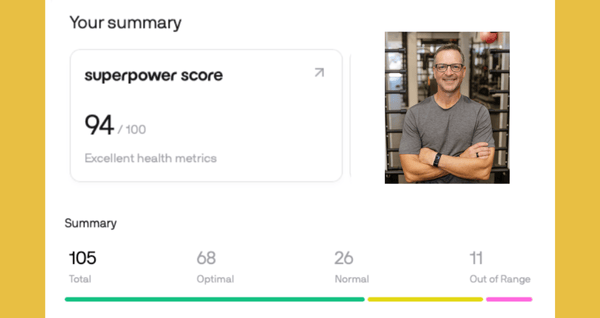
As previously mentioned, the testing is the easy part! Interpretation and a plan is where the work comes in. Superpower provided me with personalized insights to help me guide my health decisions without it being over complicated. Here’s a bit of what that looks like. A health metrics “superpower” score:

With an overview of what’s good and…maybe, not so good!

Then, recommendations to inform my wellness plan. Most helpful is a prioritization for what will have the biggest impact.

These recommendations are then followed with an individualized action plan broken out by supplements that may be beneficial, lifestyle tweaks and nutritional changes.

Finally, a specific checklist to help me start on and stay the course. This is familiar to me as I have a similar checklist of sorts already. I use a Fitbit to help me track progress on some of these daily actions and another tool called Way of Life to track other, custom goals.
Here’s my checklist from Superpower:
Daily
☐ Drink a full glass of water in the morning
☐ Get 5–15 minutes of outdoor light
☐ Prioritize protein + vegetables each meal
☐ Cook mainly with olive oil
☐ Avoid beetroot powder, coconut water, potassium‑based salts
☐ Keep alcohol to 0–3 drinks/week
☐ Take a short midday outdoor walk (when possible)
Weekly
☐ Strength training (your usual routine) [good thing I know a place…:-)]
☐ 2–3 zone‑2 sessions, 30–45 minutes
☐ HIIT no more than once per week
Sleep
☐ Keep a consistent bedtime
☐ Aim for 7–8 hours nightly
Summary
Overall, your test results can reveal what’s going on in your body. Also, knowing what your genetic makeup is can add to the meaning of these results. (NOTE: I’ll save the topic of genetics for a separate deep dive, but if you’re curious and inclined to know more, I highly recommend reading “Dirty Genes” by Ben Lynch.) Understanding what to do with those results can be challenging and Superpower does a nice job of breaking that down in layman’s terms and a specific plan. I was able to compare with my current plan and make a few adjustments. With the prevalence of UPFs, supplementation is a key piece to my wellness puzzle and I’ve come to rely on Fullscript for my trusted supplement and wellcare products.
If you’re new to diagnostic testing, I believe Superpower can be a good starting point for you. Or, if you already do regular testing, consider giving Superpower a try. The output (analysis, recommendations and plan) are solid and actionable. If you’re so inclined, here’s a link for you to leverage in getting started.
As you get deeper into it, please consider partnering with a healthcare professional with the education, training and experience to help you with your plan. It’s totally feasible to go down your own rabbit hole of unlimited testing to where it becomes too much information to process! Start small. Learn. Apply. Repeat. Maybe someday our healthcare system will put less emphasis on traditional “physicals” and focus more on meaningful diagnostic testing like this. One can hope, right!?