
Connecting Breath to Movement for Better Functional Control
TL;DR
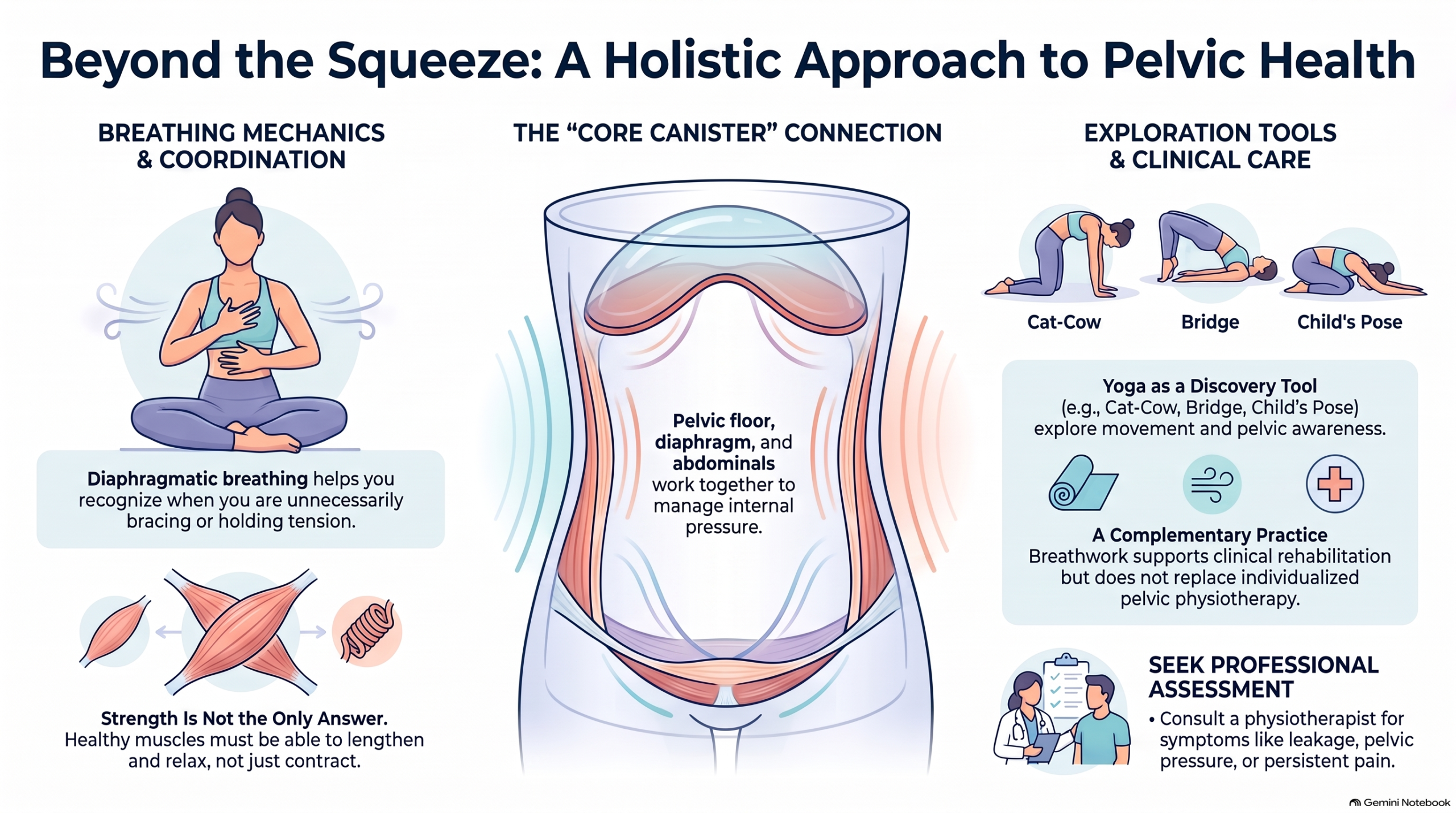
When people think about pelvic floor rehabilitation, strengthening exercises are often the first thing that comes to mind. While learning how to contract and strengthen the pelvic floor can be an important part of rehabilitation, the pelvic floor is not an isolated group of muscles. It works together with the diaphragm, abdominal muscles, and other structures of the core to help manage pressure and support the body during everyday movements.
This is where breathing can become an important part of the conversation. Diaphragmatic breathing, sometimes called deep or belly breathing, encourages greater movement through the diaphragm and lower rib cage. When combined with mindful movement, it can help people develop a greater awareness of how they engage and release their pelvic floor and core.
Breathing exercises should not be viewed as a replacement for pelvic floor muscle training or individualized physiotherapy. However, they can provide another way to explore relaxation, coordination, and functional movement as part of a broader rehabilitation program.
Are you holding your breath? How core bracing impacts your pelvic floor.
1. Understanding the Connection Between Your Breath and Pelvic Floor
The pelvic floor forms the base of the abdominal cavity, while the diaphragm sits above it. Between them are the abdominal and spinal muscles that contribute to what is sometimes described as the body’s “core canister.”
These structures work together as you breathe and move. When the diaphragm changes position during respiration, pressure within the abdominal cavity also changes. The pelvic floor responds to these internal changes, while the abdominal muscles and other core muscles contribute to stability and movement.
This does not mean, however, that every inhale or exhale automatically produces the “correct” pelvic floor response. Instead, breathing provides an opportunity to become more aware of the relationship between these different parts of the body.
Diaphragmatic breathing generally involves allowing the lower ribs and abdomen to expand comfortably during inhalation, followed by a relaxed exhalation. Rather than forcing the abdomen outward or trying to create a particular pelvic floor response, the goal is to develop a smooth, comfortable breathing pattern.
For someone working on pelvic floor rehabilitation, this awareness can be useful. It can help them recognize when they are unnecessarily holding their breath, bracing their abdominal muscles, or keeping their pelvic floor contracted when it should be able to relax.
2. Why “More Strength” Is Not Always the Answer
Pelvic floor muscles need to be strong enough to perform their roles, but strength is only one aspect of healthy pelvic floor function. These muscles also need to lengthen and relax, responding appropriately when you cough, sneeze, lift something, exercise, or change position. They also need to coordinate with the rest of your body, rather than remaining tense throughout the day.
For some people, repeatedly being told to “tighten” or “engage” their pelvic floor can make it difficult to recognize what relaxation feels like. Others may develop habits of holding their breath or bracing their entire core whenever they attempt a pelvic floor exercise. This is a major reason why rehabilitation should be individualized. Depending on the individual and their symptoms, the goal for their rehabilitation may involve strengthening, relaxation, improved coordination, or a combination of these approaches.
Mindful breathing can provide a relatively simple way to begin exploring this distinction. Instead of constantly thinking about squeezing a muscle, you can pay attention to what happens throughout the pelvis and abdomen as you breathe naturally.
3. How Diaphragmatic Breathing Can Support Pelvic Floor Coordination
Encouraging Body Awareness
One of the simplest benefits of breath-focused practice is that it encourages you to pay attention to your body. Try lying comfortably on your back, with one hand on your lower ribs, and another on your abdomen. Without forcing your breath, notice how your body moves as you inhale and exhale. You may begin to notice whether you are holding tension in your abdomen, pelvic floor, shoulder, or jaw. This awareness can be useful during rehabilitation because effective movement often starts with understanding what your body is doing before attempting to change it.
Practicing Relaxation
The pelvic floor is not meant to remain contracted constantly. Learning to release unnecessary tension can be just as important as learning to engage the muscles. Slow, comfortable breathing can be incorporated into relaxation-focused exercises, allowing you to notice whether your pelvic floor and abdominal muscles soften as you exhale. Importantly, breathing alone will not resolve pelvic floor tension, but it can be a useful component of a broader strategy developed with a pelvic health professional.
Coordinating Breath With Movement
Breathing becomes particularly relevant when you move beyond isolated exercises. Instead of practising pelvic floor contractions while lying still, rehabilitation can eventually involve coordinating your breathing and pelvic floor response with functional movements. Depending on your individual needs, this could include exercises such as bridges, squats, or other movements that replicate activities you perform in everyday life. The objective here is to develop the ability to respond to changing physical demands while maintaining appropriate control and breathing.
Building Movement Confidence
Pelvic floor rehabilitation can sometimes become overly focused on whether a person is performing a particular contraction correctly. While technique matters, the ultimate goal is usually functional: being able to move, exercise, work, and participate in daily activities with confidence. Breath and movement practices can help shift the focus toward how the entire body responds to activity.
4. Bringing Pelvic Floor Breathwork Into Your Yoga Practice
Yoga can provide a natural setting for exploring the relationship between breath and movement. Breathing techniques are already an established component of yoga practice, alongside physical postures and mindful movement.
For someone incorporating pelvic floor awareness into their practice, the emphasis should not be on finding a particular “pelvic floor pose.” Instead, yoga can provide opportunities to practice comfortable breathing, relaxation, mobility, and coordinated movement.
For example, a gentle practice might include:
- Constructive rest: Lying comfortably with the knees bent can provide a low-effort position for noticing the movement of the ribs and abdomen during breathing.
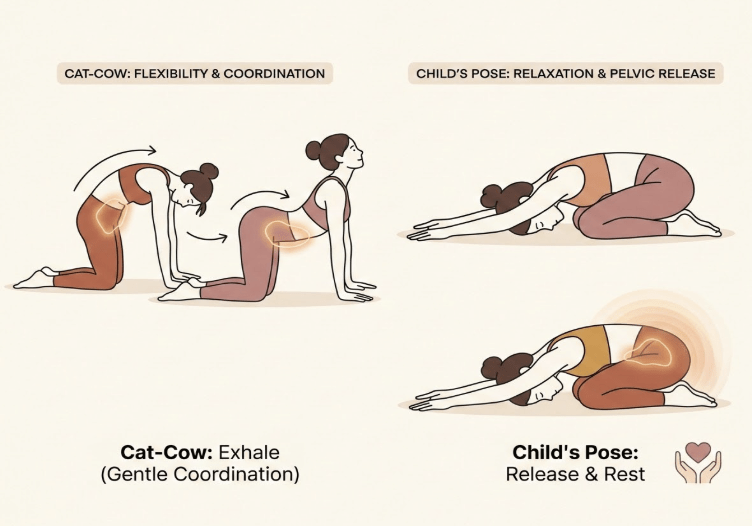
- Cat-Cow: Coordinating the breath with gentle spinal movement can encourage awareness of how the trunk and pelvis move together.
- Bridge pose: A controlled bridge can provide an opportunity to practise breathing while coordinating the abdominal, hip, and pelvic muscles during movement.
- Child’s Pose: For some people, this comfortable position can provide an opportunity to focus on slow breathing and releasing unnecessary muscular tension.
The important point is that these poses should not be viewed as treatments for pelvic floor dysfunction on their own. Their value comes from using movement as an opportunity to develop body awareness and coordination.
5. Breathing Is Not a Replacement for Pelvic Floor Strengthening
While there is a growing interest in the connection between breathing and pelvic floor function, it is important to distinguish promising concepts from established clinical evidence.
In “Can you breathe yourself to a better pelvic floor? A systematic review” (2023), Bø et al. examined whether breathing exercises could be used alone or alongside pelvic floor muscle training for urinary incontinence and pelvic organ prolapse. The researchers found that pelvic floor muscle training was generally more effective for improving pelvic floor variables and symptoms, while adding breathing exercises did not demonstrate an additional benefit in the studies reviewed. The authors concluded that evidence supporting breathing exercises as a replacement for, or in addition to, pelvic floor muscle training remains limited.
However, this does not mean that breathing has no place in pelvic health rehabilitation. Instead, this study shows that diaphragmatic breathing should be understood as one potential component of a comprehensive approach rather than a stand-alone treatment.
For some individuals, strengthening may be the primary focus. For others, learning to relax the pelvic floor, improve coordination, or modify movement strategies may be more appropriate. A qualified pelvic health physiotherapist can help determine what approach makes sense for your individual needs.
6. When Should You Work With a Pelvic Health Physiotherapist?
Pelvic floor symptoms are not something you simply have to live with, and they often look different from person to person.
You may benefit from a pelvic floor assessment if you experience:
- Urinary leakage, incontinence, or difficulty controlling your bladder
- A frequent or urgent need to urinate
- A sensation of pressure or heaviness in the pelvis
- Pelvic pain or discomfort
- Difficulty relaxing your pelvic floor
- Pain during certain activities or sexual activity
- Symptoms following pregnancy or childbirth
- Difficulty performing pelvic floor exercises correctly
- Persistent pelvic, hip, or lower-back discomfort
A pelvic health physiotherapist can assess how your pelvic floor is functioning and determine whether your rehabilitation should focus on strengthening, relaxation, coordination, or another approach. Treatment may then incorporate targeted exercises alongside breathing, mobility, posture, and functional movement. You can learn more about pelvic health physiotherapy and available treatment options at HealthMax Physiotherapy Clinics.
7. Conclusion: From “Squeeze and Hold” to Functional Control
Pelvic floor rehabilitation is about more than simply making a muscle stronger. Healthy function requires the pelvic floor to respond to the demands placed on it: contracting when support is needed, relaxing when tension is not necessary, and coordinating with the rest of the body during movement. Diaphragmatic breathing offers one way to practice that coordination. By slowing down and paying attention to how the diaphragm, abdomen, pelvis, and pelvic floor respond together, you can begin developing a better understanding of your body’s movement patterns.
For yoga practitioners, this can be a natural extension of an existing focus on breath and mindful movement. For someone undergoing pelvic floor rehabilitation, it can complement a personalized physiotherapy program. Ultimately, the goal is to move beyond the idea that pelvic health is only about strength, and toward a more complete understanding of control, coordination, relaxation, and functional movement.
If you are experiencing pelvic floor symptoms or are not sure whether your pelvic floor needs strengthening, relaxation, or a different approach, a pelvic health physiotherapist can help. At HealthMax Physiotherapy Clinics, our team can assess your individual needs and develop a rehabilitation plan designed to help you move with greater comfort, confidence, and control.
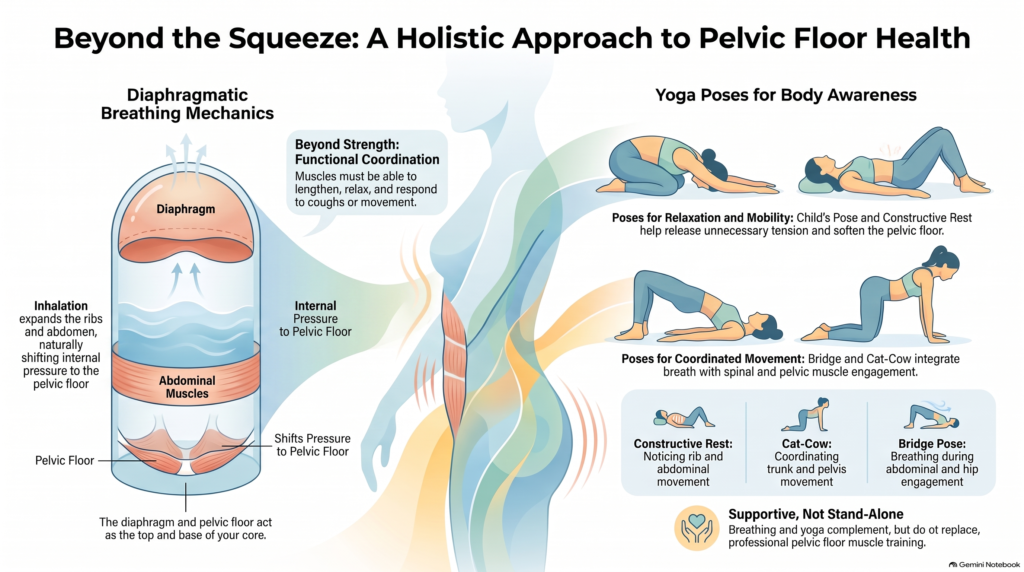
The Takeaway: Take a Breath Pelvic floor health relies on coordination, relaxation, and pressure management within the body's "core canister" rather than solely relying on muscle-strengthening or "squeeze and hold" exercises. Practicing diaphragmatic breathing alongside gentle yoga postures helps build body awareness, release unnecessary tension, and coordinate movement without core bracing. While breathwork cannot replace targeted clinical pelvic floor muscle training, it acts as a valuable complementary tool within a personalized program guided by a pelvic health physiotherapist.